

Important information: The value of investments and any income derived from them may go down as well as up. You may not get back the amount originally invested. Past performance is not a reliable indicator of future results.
Key takeaways
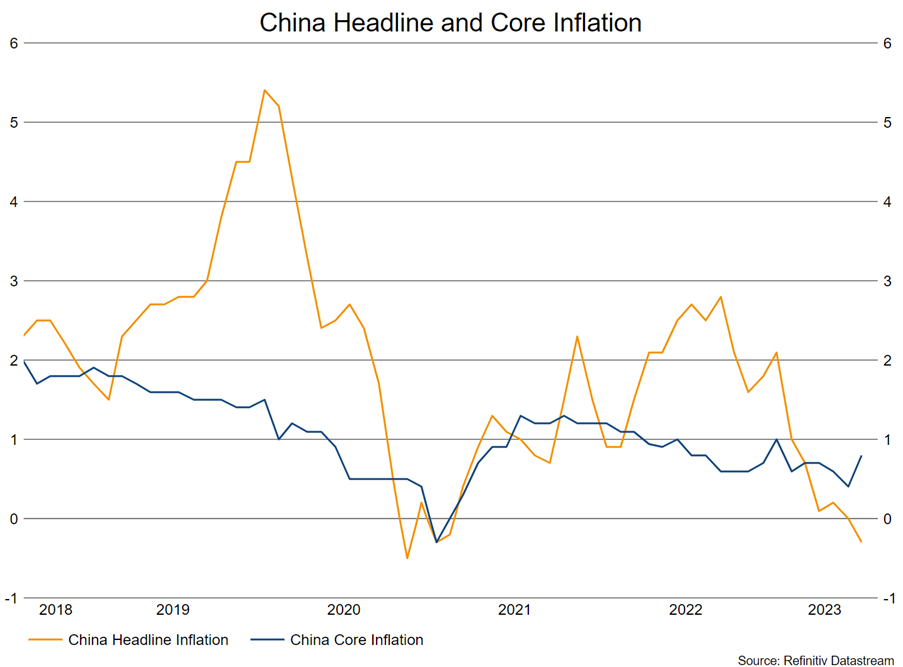 Source: Refinitiv
Will this impact other countries?
As we know, in contrast to China, most developed countries have experienced a boom in inflation over the last couple of years; a surge triggered by global supply chain issues following Covid, the Ukraine conflict and huge fiscal expansion, particularly in the US. The battle here has been to bring inflation down, rather than support rising prices, and most of responsibility for this task has fallen to central banks.
The good news for developed central banks is that if the near-term deflation we have seen in China persists, a weaker Chinese economy and currency would alleviate inflationary pressures for countries importing goods from China. Indeed, it has been reported that Chinese state bankers have been selling the US dollar, to help support the yuan, which has lost ground as China continues with loose monetary policy to support growth.
China has contributed around a third of global growth over the past decade, so a prolonged slow down will have a meaningful effect on global trade. However, as many other economies are squeezed by tighter policy and pressured consumers, some respite in the inflation battle would be welcome.
Bowmore portfolios
Whilst we do hold direct exposure to China within our core mandates, we have reduced this over time to dampen volatility and allocate towards strategies that can leverage both the Chinese equity markets, and other emerging themes and economies. We also believe that the economic backdrop in China has the potential to strengthen, with consumers rich with savings and central policy accommodative of growth.
Source: Refinitiv
Will this impact other countries?
As we know, in contrast to China, most developed countries have experienced a boom in inflation over the last couple of years; a surge triggered by global supply chain issues following Covid, the Ukraine conflict and huge fiscal expansion, particularly in the US. The battle here has been to bring inflation down, rather than support rising prices, and most of responsibility for this task has fallen to central banks.
The good news for developed central banks is that if the near-term deflation we have seen in China persists, a weaker Chinese economy and currency would alleviate inflationary pressures for countries importing goods from China. Indeed, it has been reported that Chinese state bankers have been selling the US dollar, to help support the yuan, which has lost ground as China continues with loose monetary policy to support growth.
China has contributed around a third of global growth over the past decade, so a prolonged slow down will have a meaningful effect on global trade. However, as many other economies are squeezed by tighter policy and pressured consumers, some respite in the inflation battle would be welcome.
Bowmore portfolios
Whilst we do hold direct exposure to China within our core mandates, we have reduced this over time to dampen volatility and allocate towards strategies that can leverage both the Chinese equity markets, and other emerging themes and economies. We also believe that the economic backdrop in China has the potential to strengthen, with consumers rich with savings and central policy accommodative of growth.
- Chinese headline inflation comes in negative for July at -0.3%
- Core inflation remains positive, and economic growth in mid-single digits
- Prolonged deflation could support developed economies
Source: Refinitiv
Will this impact other countries?
As we know, in contrast to China, most developed countries have experienced a boom in inflation over the last couple of years; a surge triggered by global supply chain issues following Covid, the Ukraine conflict and huge fiscal expansion, particularly in the US. The battle here has been to bring inflation down, rather than support rising prices, and most of responsibility for this task has fallen to central banks.
The good news for developed central banks is that if the near-term deflation we have seen in China persists, a weaker Chinese economy and currency would alleviate inflationary pressures for countries importing goods from China. Indeed, it has been reported that Chinese state bankers have been selling the US dollar, to help support the yuan, which has lost ground as China continues with loose monetary policy to support growth.
China has contributed around a third of global growth over the past decade, so a prolonged slow down will have a meaningful effect on global trade. However, as many other economies are squeezed by tighter policy and pressured consumers, some respite in the inflation battle would be welcome.
Bowmore portfolios
Whilst we do hold direct exposure to China within our core mandates, we have reduced this over time to dampen volatility and allocate towards strategies that can leverage both the Chinese equity markets, and other emerging themes and economies. We also believe that the economic backdrop in China has the potential to strengthen, with consumers rich with savings and central policy accommodative of growth.