

Important information: The value of investments and any income derived from them may go down as well as up. You may not get back the amount originally invested. Past performance is not a reliable indicator of future results.
Key takeaways:
 Source: Refinitiv
Attitudes towards cryptocurrencies have polarised investors and the wider public. The main idea behind crypto was an attempt to form a decentralised currency, outside of a financial system that can be expensive, inaccessible to many, bureaucratic and possibly untrustworthy. Some dreamt it would remove the need for financial third parties.
Regulators are therefore struggling to follow the innovation and change brought about by cryptocurrency, and whilst Singapore used to be a leader in championing cryptos, it has now frozen any new hub licences and asked companies to pause new operations since December 2022.
New UK crypto regulation
The current UK government has come under pressure to improve crypto regulation and oversight. A selected committee published a report this Wednesday suggesting that crypto should be treated like the gambling industry, explaining it had “no intrinsic value, huge price volatility and no discernible social good.” Bringing cryptocurrency to the level of gambling may highlight its frailties, but it would also put it outside the scope for the likes of capital gains tax, reducing revenues for the government now and, perhaps more importantly, in the future.
Any new rules brought into effect would likely force crypto exchanges to comply with the governance of traditional financial services, such as undertaking due diligence and monitoring of assets listed on their platforms, but also ringfencing customer’s money in the event of a bankruptcy.
Bowmore portfolios
Cryptocurrencies have proven to be highly volatile, and at times much maligned assets, and we do not see the argument for inclusion within a balanced, multi-asset portfolio. The speculative nature of the likes of Bitcoin reduces the ability to fundamentally assess its merits.
Cryptos are intangible assets (like currencies) but have no real value to backstop them. Additionally, crypto trading volumes are extremely low, meaning the possibility of price manipulation increases. Finally, cryptocurrencies are highly exposed to cybersecurity risks, and reliant on platforms that have been built by a select few, meaning that it is hard to trust the custody and validity of said assets.
Our wider view is that cryptocurrencies may well prove to have certain advantages for society in the long run, with blockchain (the technology on which cryptos are built) having myriad possible applications across multiple industries. However, regulation and security would need to drastically improve for us to consider them a sensible and viable investment for our portfolios.
Source: Refinitiv
Attitudes towards cryptocurrencies have polarised investors and the wider public. The main idea behind crypto was an attempt to form a decentralised currency, outside of a financial system that can be expensive, inaccessible to many, bureaucratic and possibly untrustworthy. Some dreamt it would remove the need for financial third parties.
Regulators are therefore struggling to follow the innovation and change brought about by cryptocurrency, and whilst Singapore used to be a leader in championing cryptos, it has now frozen any new hub licences and asked companies to pause new operations since December 2022.
New UK crypto regulation
The current UK government has come under pressure to improve crypto regulation and oversight. A selected committee published a report this Wednesday suggesting that crypto should be treated like the gambling industry, explaining it had “no intrinsic value, huge price volatility and no discernible social good.” Bringing cryptocurrency to the level of gambling may highlight its frailties, but it would also put it outside the scope for the likes of capital gains tax, reducing revenues for the government now and, perhaps more importantly, in the future.
Any new rules brought into effect would likely force crypto exchanges to comply with the governance of traditional financial services, such as undertaking due diligence and monitoring of assets listed on their platforms, but also ringfencing customer’s money in the event of a bankruptcy.
Bowmore portfolios
Cryptocurrencies have proven to be highly volatile, and at times much maligned assets, and we do not see the argument for inclusion within a balanced, multi-asset portfolio. The speculative nature of the likes of Bitcoin reduces the ability to fundamentally assess its merits.
Cryptos are intangible assets (like currencies) but have no real value to backstop them. Additionally, crypto trading volumes are extremely low, meaning the possibility of price manipulation increases. Finally, cryptocurrencies are highly exposed to cybersecurity risks, and reliant on platforms that have been built by a select few, meaning that it is hard to trust the custody and validity of said assets.
Our wider view is that cryptocurrencies may well prove to have certain advantages for society in the long run, with blockchain (the technology on which cryptos are built) having myriad possible applications across multiple industries. However, regulation and security would need to drastically improve for us to consider them a sensible and viable investment for our portfolios.
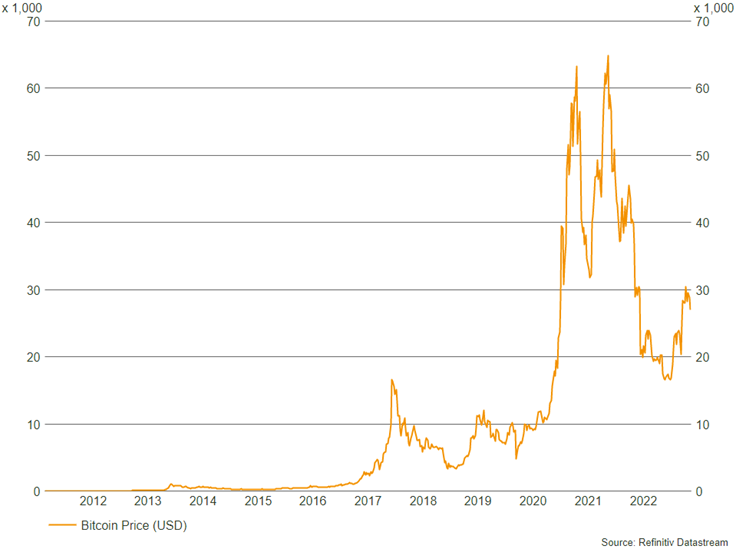
- The price of Bitcoin peaked in November 2021 and has completely collapsed since then, dropping in value from a high of c.$65,000 to around $28,000 per coin today
- The bankruptcy of FTX has hurt investor confidence and caused many e-wallet casualties
- We hold no exposure to cryptocurrencies in any of the Bowmore portfolios
- We hold no exposure to cryptocurrencies in any of the Bowmore portfolios.
Source: Refinitiv
Attitudes towards cryptocurrencies have polarised investors and the wider public. The main idea behind crypto was an attempt to form a decentralised currency, outside of a financial system that can be expensive, inaccessible to many, bureaucratic and possibly untrustworthy. Some dreamt it would remove the need for financial third parties.
Regulators are therefore struggling to follow the innovation and change brought about by cryptocurrency, and whilst Singapore used to be a leader in championing cryptos, it has now frozen any new hub licences and asked companies to pause new operations since December 2022.
New UK crypto regulation
The current UK government has come under pressure to improve crypto regulation and oversight. A selected committee published a report this Wednesday suggesting that crypto should be treated like the gambling industry, explaining it had “no intrinsic value, huge price volatility and no discernible social good.” Bringing cryptocurrency to the level of gambling may highlight its frailties, but it would also put it outside the scope for the likes of capital gains tax, reducing revenues for the government now and, perhaps more importantly, in the future.
Any new rules brought into effect would likely force crypto exchanges to comply with the governance of traditional financial services, such as undertaking due diligence and monitoring of assets listed on their platforms, but also ringfencing customer’s money in the event of a bankruptcy.
Bowmore portfolios
Cryptocurrencies have proven to be highly volatile, and at times much maligned assets, and we do not see the argument for inclusion within a balanced, multi-asset portfolio. The speculative nature of the likes of Bitcoin reduces the ability to fundamentally assess its merits.
Cryptos are intangible assets (like currencies) but have no real value to backstop them. Additionally, crypto trading volumes are extremely low, meaning the possibility of price manipulation increases. Finally, cryptocurrencies are highly exposed to cybersecurity risks, and reliant on platforms that have been built by a select few, meaning that it is hard to trust the custody and validity of said assets.
Our wider view is that cryptocurrencies may well prove to have certain advantages for society in the long run, with blockchain (the technology on which cryptos are built) having myriad possible applications across multiple industries. However, regulation and security would need to drastically improve for us to consider them a sensible and viable investment for our portfolios.