
· Memory prices have risen nearly 8-fold over the last 12 months[i]
· The Korean stock market has risen to be larger in size than the UK, France and Germany[ii]
· Samsung’s share price fell on the day it announced a 19-fold increase in profits[iii]
You would be forgiven for not tracking the performance of the “inSpectrum Tech Inc NAND FLASH Spot Price TLC Flash 512Gb” index over the last few years. It represents the price of a broadly commoditised piece of electronic equipment otherwise known as flash memory. Flash memory is an electronic storage technology used in devices all over the world to store and retain data – it has no moving parts, rather it uses electronic gates to store data in zeros and ones, i.e. binary.
The reason Bowmore have been tracking the NAND Flash Spot Price index recently is that it has increased in price by nearly 8 times since August 2025[iv], having been fairly stable since 2022 when the index began tracking the price.
Companies that produce flash memory have found themselves producing an enormously valuable commodity. The chart below from Deutsche Bank[v] shows the market capitalisation of three of the leading players has risen by around 5-10 times over the past year.
[i] Mainstream NAND Flash Wafer Spot Price | DataTrack
[ii] Deutsche Bank
[iii] Chip stocks sell off as high expectations overshadow Samsung results
[iv] Mainstream NAND Flash Wafer Spot Price | DataTrack
[v] Deutsche Bank Research
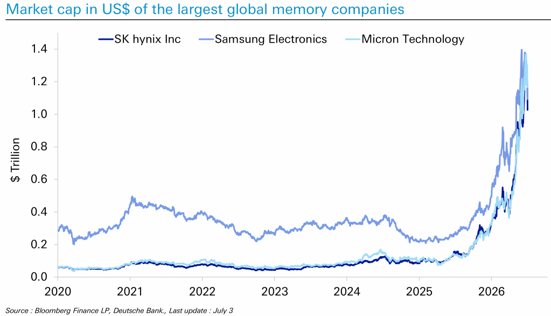
Two of these big companies are listed on the Korean exchange (SK Hynix and Samsung Electronics), and this has contributed in large part to the Korean Composite Stock Price Index (KOSPI) more than doubling over the last 12 months[i]. In fact, the growth of these two companies has contributed significantly to the size of the Korean stock market outstripping the stock markets of the UK, France and Germany[ii].
Priced to perfection
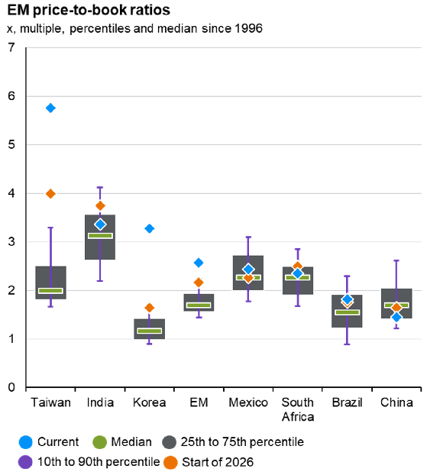
Whilst prices have been rising for these companies, future earnings expectations have been rising even faster, leading to a slightly odd scenario where these companies are becoming optically cheaper, despite their booming share prices.
The price to book value ratio, which shows a company’s share price divided by its net assets, is represented on the chart below and shows Korean companies are trading considerably above their long-term averages[iii]. This measure looks at the current assets of the firm and not future earnings, but in any case, it does highlight the exuberance of these firms and how their prices are stretched by historical standards.
[i] AlphaTerminal
[ii] Deutsche Bank
[iii] JPMorgan Guide to the Markets
Furthermore, Samsung’s share price actually fell on the day it posted a 19-fold increase in profits. Even outstanding revenue growth appeared to not meet the lofty expectations of the market[i].
A dislocated market
The memory market has become frenzied for a number of reasons. Firstly, AI chips, such as those produced by Nvidia, rely heavily on specialized memory for which production has been booked out already, leading to supply constraints in other areas of the memory market.
Secondly, memory is increasingly becoming a requirement in AI applications for high-speed, long-duration data storage. The massive purchasing by large US firms has shifted towards memory recently as they stockpile memory for data centre build outs. If you want to ask an AI model to perform tasks for you, you would like it to retain that content in the future and be usable again rather than an ephemeral response that is lost forever.
Finally, after previous memory market downturns, the top manufacturers collectively reduced factory output to digest excess inventory. Instead of ramping production back up to normal levels when demand returned, suppliers have tightly controlled factory utilisation.
As with previous cycles, supply imbalances and higher prices may encourage additional production capacity over time causing the cycle to turn.
Bowmore Portfolios
As we wrote last week, we recently sold an Emerging Markets fund which had significant exposure to the large semi-conductor and memory manufacturers. There may well be further to run in this frenzy, but we are happy to lock in profits and redistribute elsewhere into areas of that are less crowded.
Over the last 12 months, a Core portfolio at Risk Profile 5 (which is broadly 60% equities) has returned 16.6% gross. Part of our investment philosophy is to avoid over exuberance in markets and therefore we are delighted to lock in some strong returns for clients and focus on the future and investment opportunities at more sensible valuations.
[i] Chip stocks sell off as high expectations overshadow Samsung results
[1] Mainstream NAND Flash Wafer Spot Price | DataTrack
[2] Deutsche Bank
[3] Chip stocks sell off as high expectations overshadow Samsung results
[4] Mainstream NAND Flash Wafer Spot Price | DataTrack
[5] Deutsche Bank Research
[6] AlphaTerminal
[7] Deutsche Bank
[8] JPMorgan Guide to the Markets
[9]Chip stocks sell off as high expectations overshadow Samsung results