

Important information: The value of investments and any income derived from them may go down as well as up. You may not get back the amount originally invested. Past performance is not a reliable indicator of future results.
Key takeaways
 Source: Refinitiv
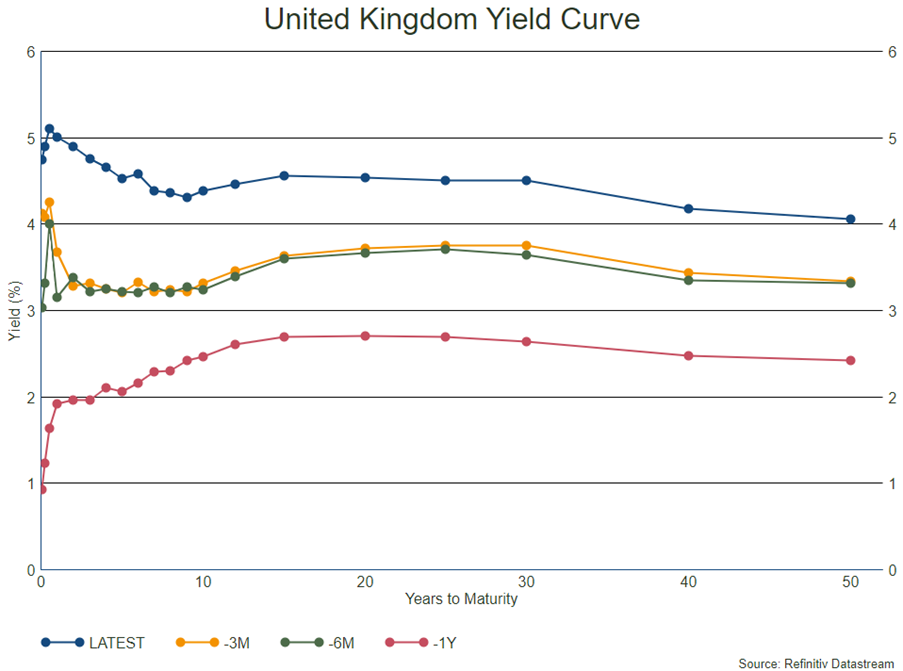
The above chart shows how gilt yields have risen over time, with the blue line representing current yields over different maturities, against the pink line, representing yields a year ago.
Why have gilt yields risen?
With the Bank of England raising interest rates to combat inflation, bond investors have the opportunity to reallocate resources in search of better returns. This puts downward pressure on gilt markets and as the price of bond assets drop, yields rise.
Inflation expectations therefore have a big part to play in the direction of bond markets. If inflation remains ’sticky’ at more elevated levels, a bond market rally may be protracted, but investors are now being paid more for their allocations. As a result, investors are adjusting their outlook on gilts and are becoming more positive regarding government debt.
Bowmore portfolios
The UK government has previously announced that inflation will have halved by the end of 2023, something that largely takes care of itself as energy price inflation falls away. With peak interest rate expectations for the UK priced in around the 5.0 - 5.5% mark, it is feasible that we start to see rates decline next year, with a view to alleviate pressure in the housing market and support the economy.
We believe the move higher in yields presents an opportunity to add exposure to direct gilts, and we have started introducing an allocation this week. By doing so we are able to reduce the underlying cost of holdings, whilst lowering volatility in portfolios and providing a defensive position should economic conditions worsen in the UK. If rates do start to fall, this will be supportive in the longer term.
Source: Refinitiv
Source: Refinitiv
The above chart shows how gilt yields have risen over time, with the blue line representing current yields over different maturities, against the pink line, representing yields a year ago.
Why have gilt yields risen?
With the Bank of England raising interest rates to combat inflation, bond investors have the opportunity to reallocate resources in search of better returns. This puts downward pressure on gilt markets and as the price of bond assets drop, yields rise.
Inflation expectations therefore have a big part to play in the direction of bond markets. If inflation remains ’sticky’ at more elevated levels, a bond market rally may be protracted, but investors are now being paid more for their allocations. As a result, investors are adjusting their outlook on gilts and are becoming more positive regarding government debt.
Bowmore portfolios
The UK government has previously announced that inflation will have halved by the end of 2023, something that largely takes care of itself as energy price inflation falls away. With peak interest rate expectations for the UK priced in around the 5.0 - 5.5% mark, it is feasible that we start to see rates decline next year, with a view to alleviate pressure in the housing market and support the economy.
We believe the move higher in yields presents an opportunity to add exposure to direct gilts, and we have started introducing an allocation this week. By doing so we are able to reduce the underlying cost of holdings, whilst lowering volatility in portfolios and providing a defensive position should economic conditions worsen in the UK. If rates do start to fall, this will be supportive in the longer term.
Source: Refinitiv
- Strong wage growth, inflation and interest expectations push UK gilt yields close to 5%
- Five-year mortgage rates at 4.3%, up from 1.3% two years ago
- We are introducing direct gilt exposure to portfolios
Source: Refinitiv
The above chart shows how gilt yields have risen over time, with the blue line representing current yields over different maturities, against the pink line, representing yields a year ago.
Why have gilt yields risen?
With the Bank of England raising interest rates to combat inflation, bond investors have the opportunity to reallocate resources in search of better returns. This puts downward pressure on gilt markets and as the price of bond assets drop, yields rise.
Inflation expectations therefore have a big part to play in the direction of bond markets. If inflation remains ’sticky’ at more elevated levels, a bond market rally may be protracted, but investors are now being paid more for their allocations. As a result, investors are adjusting their outlook on gilts and are becoming more positive regarding government debt.
Bowmore portfolios
The UK government has previously announced that inflation will have halved by the end of 2023, something that largely takes care of itself as energy price inflation falls away. With peak interest rate expectations for the UK priced in around the 5.0 - 5.5% mark, it is feasible that we start to see rates decline next year, with a view to alleviate pressure in the housing market and support the economy.
We believe the move higher in yields presents an opportunity to add exposure to direct gilts, and we have started introducing an allocation this week. By doing so we are able to reduce the underlying cost of holdings, whilst lowering volatility in portfolios and providing a defensive position should economic conditions worsen in the UK. If rates do start to fall, this will be supportive in the longer term.
Source: Refinitiv